

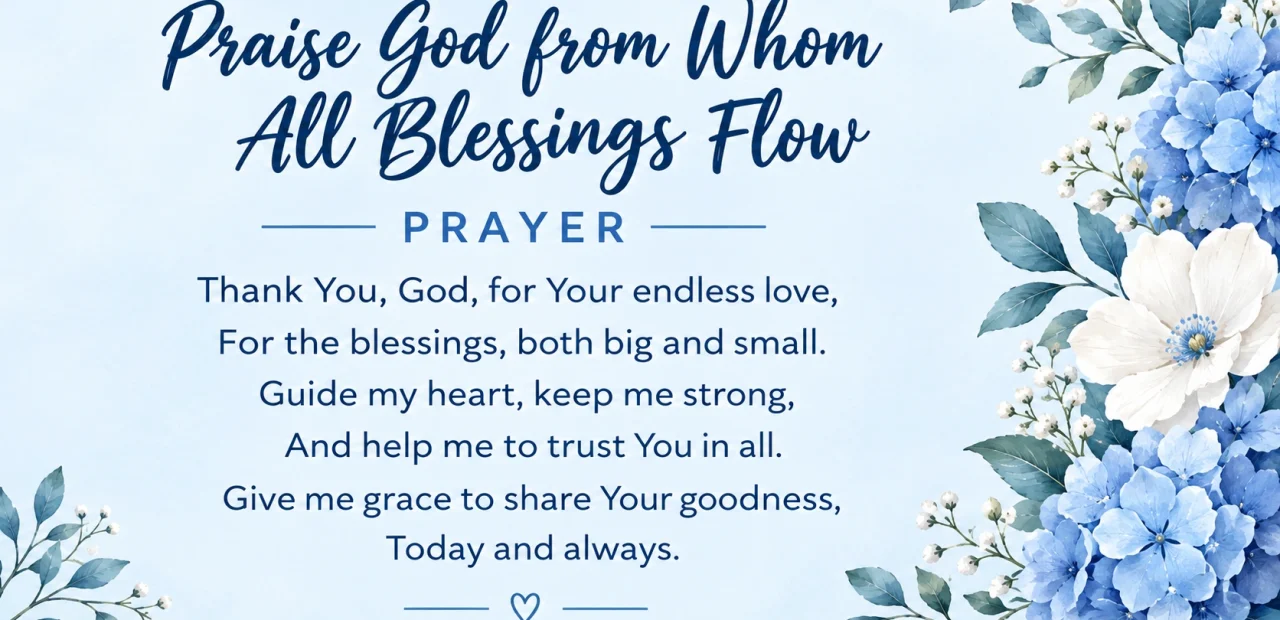
Some lines get sung so often they stop being noticed. “Praise God from whom all blessings flow” is one of them — four short lines that show up at the end of services, before meals, and at gatherings where nobody planned any music at all.
People search for it for different reasons. Some want the full wording. Others want to know where it came from, or how to use it as a prayer rather than a song.
The line is the opening of what most churches call the Doxology. It’s older than the hymnals it sits in, and it has outlasted nearly every song it was written alongside.
What follows covers where it came from, what it actually says, and how it works as a spoken prayer. There are also prayers of praise and Bible verses about blessing that fit the same purpose, for anyone who wants words to use rather than only background.
Where the Doxology Came From
The verse was written by Thomas Ken, an English bishop who lived from 1637 to 1711. He wrote it as the closing stanza of longer hymns intended for students at Winchester College — one for morning, one for evening.
The closing stanza became more widely known than the hymns it belonged to. Churches began using it on its own, and it eventually acquired the shorthand name it still carries.
The word doxology comes from Greek roots meaning words of glory. It refers broadly to any short expression of praise to God, not only to this one.
What the Words Actually Say
The four lines are compact, and each does a different job.
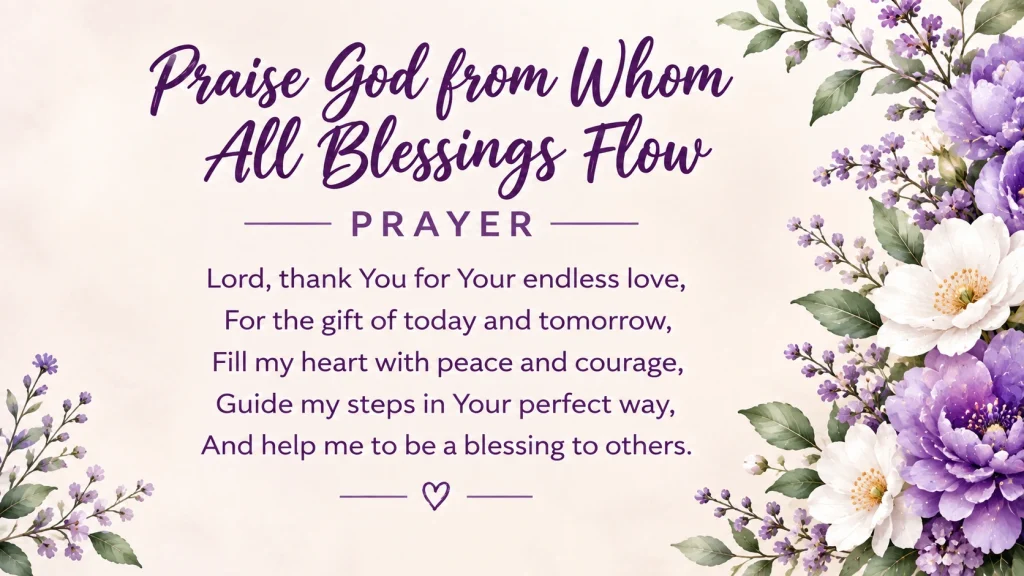
The opening line names God as the source of every blessing. Not some of them. All of them.
The second line calls on all creatures to praise him. The third turns to the heavenly host. The fourth addresses God as Father, Son, and Holy Ghost.
It moves from earth to heaven to the Trinity in about twenty-five words. That compression is part of why it stayed in use for over three centuries.
Why Churches Still Use It
It’s short enough to sing from memory. No hymnal needed, no rehearsal, no accompaniment.
It also fits almost anywhere. Congregations use it after the offering, at the end of a service, before a meal, and at weddings and funerals alike.
Many people learned it as children and can still sing it decades later without thinking. That kind of familiarity does something a new song can’t.
Using It as a Spoken Prayer
The Doxology works just as well said as sung. Some people say it before a meal instead of a longer grace. Others use it to close a prayer time.
Reading it slowly changes the experience. Sung at normal tempo, it’s over in fifteen seconds. Spoken one line at a time, the meaning has room to land.
A simple approach: say the first line, pause, and name three actual blessings from the past week before continuing.
Prayers of Praise for Everyday Use
These carry the same spirit and are short enough to remember.
- Lord, thank you for being the source of every good thing in this house, named and unnamed.
- Praise God for the blessings noticed today and the many that went unnoticed.
- Thank you, Father, for provision that came on time, sometimes at the last possible moment.
- Lord, thank you for health, work, and people worth loving. All of it came from you.
- Praise God for what he protected this family from without anyone ever finding out.
- Thank you for the ordinary days. They’re the ones that made up most of this year.
- Lord, receive praise from this house before any requests are made.
- Thank you, God, for faithfulness that didn’t depend on anyone deserving it.
Short Blessings to Share
Easy to copy into a message or a card.
- Praise God from whom all blessings flow. Wishing you a day full of them.
- May every blessing today remind you where it came from.
- Blessings on you and your home. God has been good.
- Thankful to God for you today.
- May praise come easily to you this week.
- Grateful for a God who gives before anyone asks.
Bible Verses About God as the Source of Blessing
The references below are accurate, and the descriptions are paraphrased rather than quoted word for word. Reading them in a full translation is worth the extra minute.
James 1:17 — describes every good and perfect gift as coming down from the Father of lights.
Psalm 103:1–2 — calls on the soul to bless the Lord and not forget his benefits.
Ephesians 1:3 — speaks of God blessing believers with every spiritual blessing in Christ.
Psalm 150:6 — closes the psalms with a call for everything that has breath to praise the Lord.
1 Chronicles 29:11 — a prayer of David acknowledging that greatness, power, and glory belong to God.
Psalm 34:1 — speaks of blessing the Lord at all times, with praise continually on the lips.
Revelation 5:13 — describes every creature in heaven and on earth giving praise, which closely matches the shape of the Doxology itself.
When the Doxology Fits Best
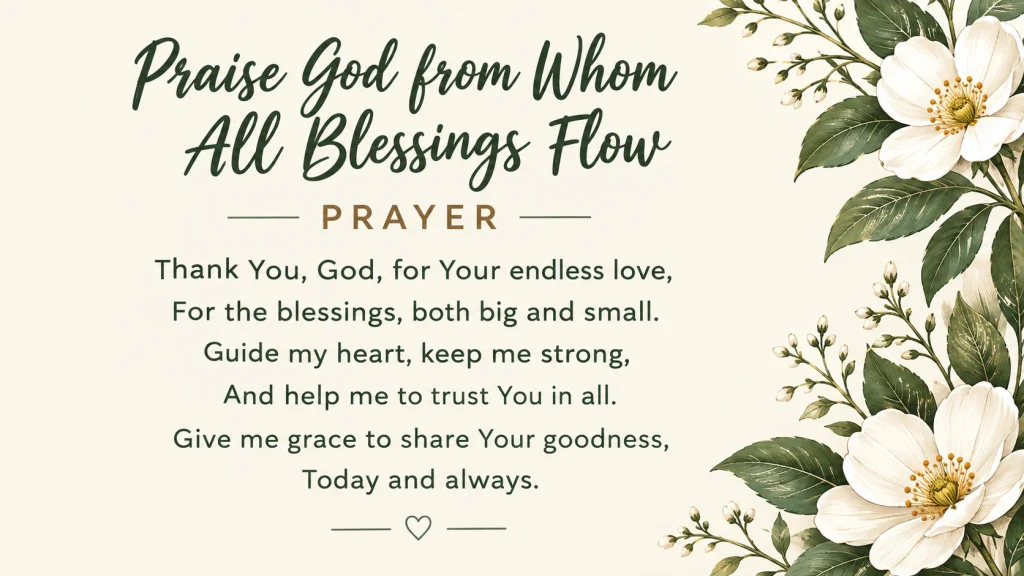
Before a meal, when a long grace isn’t needed, and everyone’s hungry.
At the end of family prayer time, as a natural closing line.
After good news arrives — a clean scan, a job offer, a safe arrival.
At funerals, where familiar words often carry people further than new ones.
In private, on a morning when gratitude is there but the right words aren’t.
Many people also use it as a first thought on waking. It sets the day facing the right direction before anything else gets a say.
Teaching It to Children
Short verses stick with children in a way long ones don’t. Four lines is manageable.
Singing it at the same moment each day helps — before dinner, or at bedtime. Repetition does the work.
Explaining the first line matters more than explaining all four. Blessings come from God is a complete idea on its own, and a child can hold onto it.
Most adults who sing it from memory learned it young. That’s worth remembering.
Final Verdict
“Praise God from whom all blessings flow” has lasted more than three hundred years because it’s short, true, and easy to remember when nothing else comes to mind.
Use it as a prayer, not only a song. Say it before meals. Say it when good news arrives. Say it on mornings when gratitude is there, but words aren’t.
May the blessings in your life keep pointing back to their source. May praise come easily to you, and may the people in your home learn these words early enough to carry them a long way.



One response